
“Literally nothing a CEO or CHRO does will authentically, structurally, and sustainably change the value of your organization more.”
This is a statement from the recently released book1 written by Jim Clifton, Chairman and CEO of Gallup, and Jim Harter, PhD, Chief Workplace Scientist for Gallup, based on their research and more than 30 years of data, to help workplaces thrive and produce something the whole world wants.
What they are referencing is “improving your ratio of great to lousy managers”. The key to this, however, rests solely with leaders.
It’s Both
To succeed today in any position of authority we need to both lead and manage.
Leadership is a role to establish a clear vision for a mission that inspires others to follow and then enable achievement through times of both conflict and harmony.
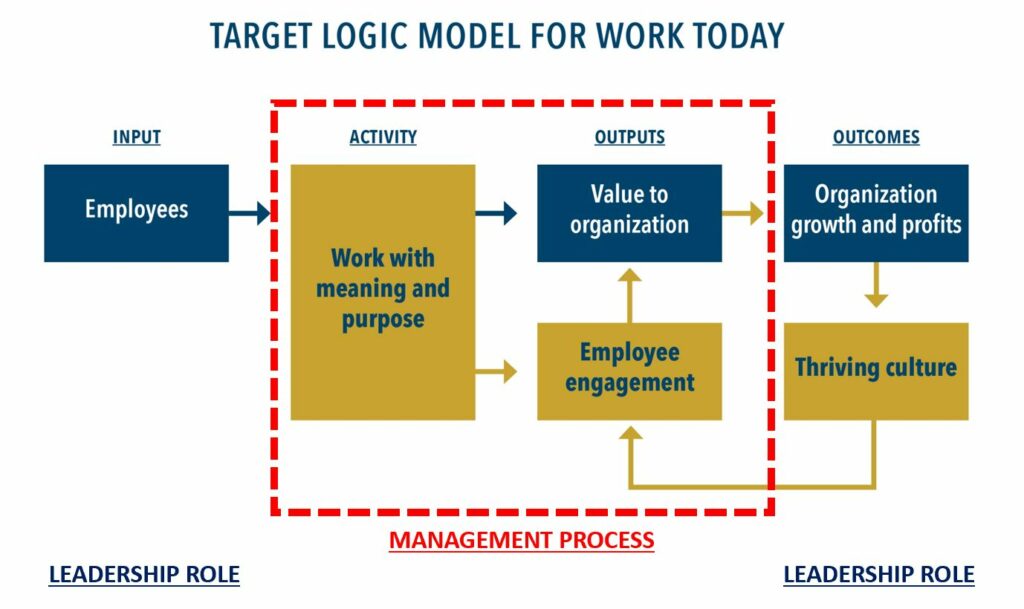
Management is a process to organize and coordinate activities to produce defined outputs.
In the target logic model for work today, leadership is responsible for providing the highest quality of “inputs”, in this case employees, including principals and managers. Leaders are also responsible for creating the conditions necessary to realize the “outcomes” of greater organizational growth and profits and a thriving culture that reinforces production.
This is illustrated in the graphic below from my book, Reversing Burnout. How to Immediately Engage Top Talent and Grow:
To effectively manage today, we need to be able to connect with others as people – not just as an “employee”, a “member” of the team, or an “asset” to the organization. If we lose sight and treat those in our care more as “instruments” of our success, we won’t fully engage or inspire.
Math Problem
There’s been a failure to engage, and we can’t ignore the numbers.
It is well researched and reported that 70 percent of the variance on team and individual employee engagement rests solely on their managers. Gallup cites this as “the single most profound, distinct and clarifying finding – ever.” Yet, despite all the increased talk and attention, employee engagement remains stubbornly low. Why?
Gallup research also shows that 67 percent of managers – those with the most influence on employee engagement – are not engaged themselves. This is a problem that cannot solve itself. It’s impossible to engage, grow, and inspire others when those responsible are not engaged, growing, or inspired themselves.
“It’s impossible to engage, grow, and inspire others when those responsible are not engaged, growing, or inspired themselves.”
–Peter C. Atherton
The only way to get the math to work in our favor, and enjoy the vast array of benefits that go along with increased employee engagement, is to increase the number of engaged managers.
“The only way to get the math to work in our favor, and enjoy the vast array of benefits that go along with increased employee engagement, is to increase the number of engaged managers.”
–Peter C. Atherton
Engaging Managers
To satisfy our engagement need (i.e., to feel good about, connected to, and grow in our work) at any level, we need to be acknowledged and cared for on the job. (See Part 1 of this series for more on this).
To better engage managers, leaders must be willing to:
- Fully recognize the importance of the manager position and the fact that it is mission-critical to organizational success – leaders cannot implement a great vision, strategy, or project alone.
- Take action to better understand and address the stress, overwhelm, and the burnout experienced by managers through better education, training, and capacity building.
- Teach, model, and incentivize employee development, innovation, and cross-team collaboration.
The higher we, as leaders, have ascended in terms of our personal and professional growth (again, see Part 1 of this series for more), the easier this will be – especially given what it takes to effectively engage today.
Meaning Matters
To be engaged, we need work that matters – work with both meaning and purpose – as presented in the “target logic model” and as further defined by Clifton and Harder:
Gallup defines a “good job” as working full time for an organization, with 30+ hours a week and a living-wage paycheck.
A “great job” has all the qualities of a good job but with one big differentiator: Employees are engaged in meaningful and fulfilling work and they feel they are experiencing real individual growth and development in the workplace.
To maximize outputs and outcomes, leaders need to become great managers of managers and together create “great jobs”.
“To maximize outputs and outcomes, leaders need to become great managers of managers and together create “great jobs”.”
–Peter C. Atherton
What should leaders do?
- Take inventory – would your managers tell others they have a “great job”? Do you know the meaning your managers derive from their work… and do you encourage and help connect them to their goals and aspirations?
- Check your mission – does it matter to your team and to others you want to attract and engage?
- Update your strategic planning – ensure that it focuses on the growth and development of your managers as critical success drivers.
- Be in a position to inspire – do you authentically serve and effectively advance others? Do you model the behaviors needed for team and organizational growth?
- Build capacity – increase learning and address workload. Being too busy for too long – especially for those in positions of authority – leads to loss.
- Have the courage to trigger and enable needed change – it’s our role at all times.
Part 3 of this series focuses on how to make these internal investments work more in our – and our clients’ – favor.