
Whether in an executive or management role, most of what we do today as leaders is not leadership.
In a world of always urgent and constant busy, it can seem necessary to rely on our skills to win quarters and rescue projects, but that’s not the only thing needed.
What is needed is for us to inspire a “better future” and provide day-to-day opportunities for our teams to help make it a reality.
If that seems soft, that’s a problem. That is why employee engagement is low and performance remains less than it could be.
Our strength as leaders today is in our ability to connect and enable others to become their best selves as part of our work, not in affirming our positions and showcasing skill sets that only perpetuate our current cycle.
For things to change we, as leaders, need to “see more” and “do differently”.
Raising Awareness
First, we must recognize there is a problem when over two-thirds of employees are routinely disengaged, and burnout and career pivoting is on the rise.
Leaders have the most prominent role in solving this… but are often too consumed and not aware enough to do so.
Emotional intelligence is a measure of our self-awareness, self-management, social-awareness, and our relationship management. Emotionally intelligent people are more successful and are better leaders. Emotional intelligence is what draws people to like, know, and trust us. Emotionally intelligent people can attract and inspire others up and down the corporate ladder. Interactions with emotionally intelligent people are more relational and less transactional – which makes them so much more effective. On average, however, we lose emotional intelligence as we progress in our careers.
The graphic below from the book “Emotional Intelligence 2.0” (Drs. Travis Bradberry and Jean Greaves) and referenced in my book, “Reversing Burnout. How to Immediately Engage Top Talent and Grow! A Blueprint for Professionals and Business Owners”, illustrates this very point.
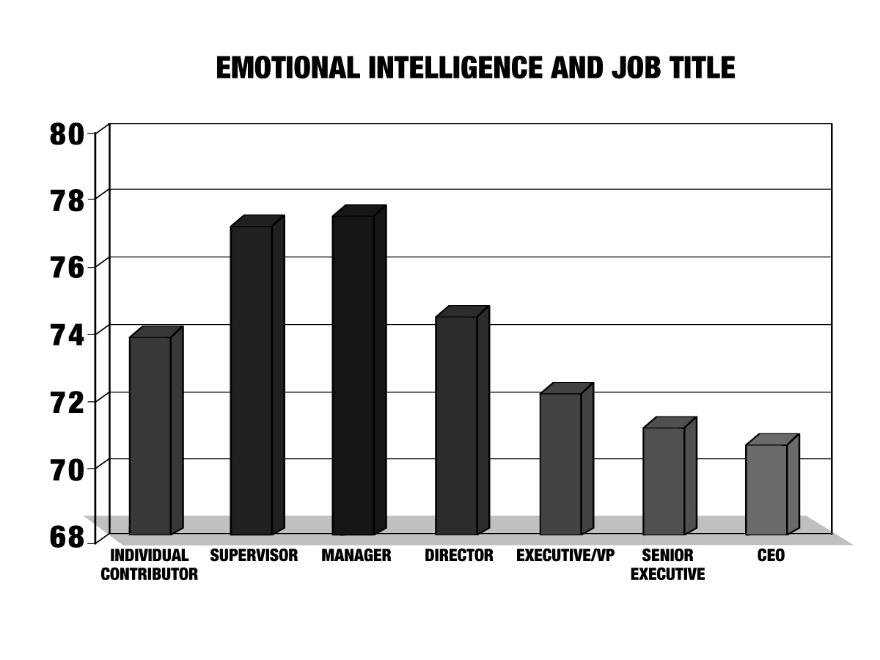
As leaders, and as a leadership team, we need to work especially hard to beat this trend if we want to be more competent, relevant and effective today in terms of employee engagement and moving our organizations forward.
Self-Care
Most leaders are overwhelmed and many are burning-out. This is not good for us, our teams, our organizations, and those we care for outside of the office.
We need to face the reality that we carry heavy workloads and burdens in the A/E industry. Without appropriate margin and rest built into our schedules we become fatigued, less creative, and less engaging.
To maintain growth and performance over the long-term, we need to put on our own “oxygen mask” first. Executive leadership needs to determine how best to design and enforce personal growth and refresh strategies for themselves and others.
Fully seeing what’s happening to and around us positions us to move forward.
A Mission That Matters
Top talent and clients want to participate in pursuits that matter to them and to the world around them. Without such a mission, employee engagement seldom lasts.
Top organizations establish a clear vision of why they exist and articulate why their top and bottom line growth is a part to realizing something greater.
Top leaders align and connect day-to-day actions with realizing our full potential in pursuit of the vision.
Conditions That Engage
Today, leaders need to systematically analyze (and possibly redesign) how we do work to better engage and develop our talent.
Strategies that include “process” as well as “product” improvements are more inclusive within a team and throughout an organization… and can be designed to support our goals related to culture, sustainability, diversity, and innovation.
Walking the Talk
Talk is cheap. Just talking about change disengages.
For most firms, strategic plan implementation has already taken too long or has become “back-burnered” due to the urgent and the busy cycles we help perpetuate.
Leaders: we can’t expect positive changes if we don’t initiate them, personally model what they look like, and incentivize what it takes. Raise awareness. Take care of people. Get to the root of issues. Remove hurdles. Invest in training. Hire coaches. Inspire connection, performance, innovation, and impact. Communicate results.
Doing so, sets our managers and employees up to help break the current cycle, drive our growth and success, and realize our better future.
Part 3 and Part 4 of this series focuses on the specific roles of managers and employees. A link to the previous article is here: The New Rules of Employee Engagement – Part 1: Know Your Role.